New Recipe Up

I know all this is moving painfully slowly. However I’ve got the below Cardinal slice recipe updated now with the new formula and process. I’ll try to post the result this afternoon. However it’s so darn gloomy here I don’t know how well my “hero shot” will turn out. I’ll do my best!

READ ON

Making Stabilized Whipped Cream

Sure, there are plenty of purists out there who don’t believe cream should be polluted with stabilizers. I’m with them…some of the time. The rest of the time I’m worried about my whipped cream holding up for long periods, on warm days or in the freezer. Then I’m looking for a little somethin’-somethin’ to help get me by.

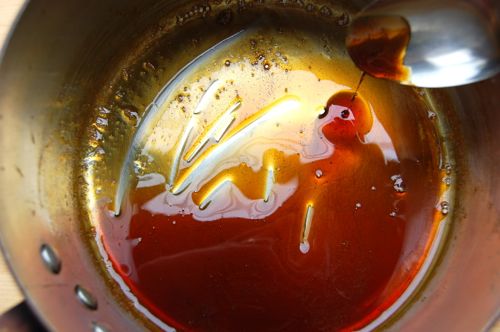
That something is gelatin. Just a little will do wonders you whipped cream’s stability, and honestly, it barely impacts the taste or texture. Start by melting a little gelatin. For 2 cups of cream you’ll start with a 1/2 teaspoon of powdered gelatin and a little ice water. Yes, these are my little silicone Trudeau bowls again. I love them, that’s why I plug them. They’re wonderful:

READ ON

OK, Kiddos…

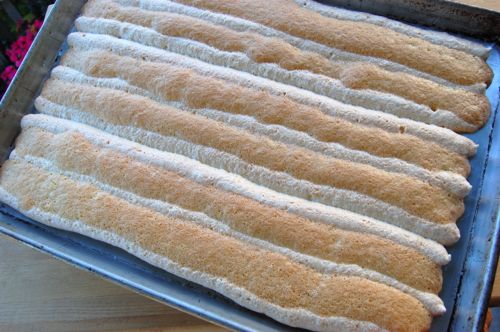
NOW we’re cookin’ with gas! Cardinal slices are a study in the effects of over-whipping. For that reason alone I recommend them. The ladyfinger batter is a very particular lady. She wants to be danced with, but not too much. If there’s too much agitation, the bubbles in the batter get too big, the rise gets too aggressive, and the sponge becomes so delicate that it can’t hold its own weight.

The same seems to be true with the meringue. I’ll confess it never occurred to me until today that meringue can be over-whipped. It appears that when it is, it can suffer from some of the same problems: over-puffing in the heat of the oven, then collapse when it cools. Fascinating…as Mr. Spock would say. Right…on to shaping and the most important part: eating. This is going to be good!

READ ON

Cardinal Slice Follies

So OK, this is a slow project. But let me tell you, this is a challenging pastry. I’ve done it maybe seven times now and I’m still not happy with where I am. I’m starting to see why there are so few recipes for this pastry in English.

There are several technical issues with the cake. First, it calls for two batters, baked in alternate stripes, right next to each other. Both are fussy: meringue and ladyfinger. One traditionally calls for low heat, the other for high heat. Formulated and baked just right, they coexist in beautiful harmony. But therein lies the rub. If you’ve ever seen a cardinal slice, you know the layers have a fluted appearance. Like so:

READ ON

Pie Case of the Gods

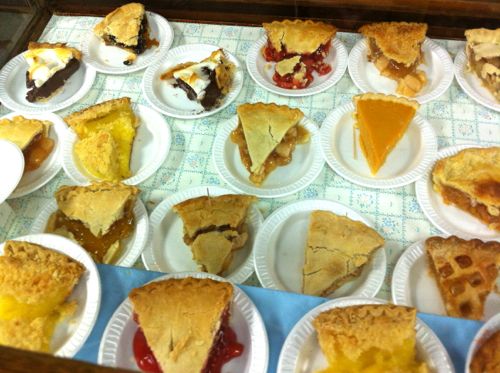
Fall isn’t complete in the Pastry household without a trip to west-central Indiana and the Covered Bridge Festival. Few people know it, but it’s Parke County, Indiana and not Madison County, Iowa that is the real covered bridge capital of America. The fact that no one’s every made a sappy movie about Parke County starring Meryl Streep is big point of pride there. They’ve got over 30 covered bridges, but then who am I kidding? The only reason I go is for the food.

READ ON

Cardinal Slice Recipe

This basic recipe appears in lots of places, but probably originates in Baking With Julia, a true treasure of a book (buy it as soon as you can). The original recipe is for a three-layer pastry, but you can make it into a two-layer if you prefer. I’ll tell you how later in the post. For the meringue you’ll need:

READ ON

Why are they called “Cardinal” slices?

That’s something I want to know too, reader Dean. They aren’t named for the birds, I know that much. Which leaves only church Cardinals, presumably of the Catholic variety. Various entries I’ve found on cardinal slices claim that the colors of the pastry — gold, white and (at least traditionally) red — correspond to the colors of the Catholic Church. However speaking as a Catholic, I’m fairly certain that the church doesn’t have an official color palette. It has the cross — its official “logo” — and the colors of the liturgy, which is to say the various colors that are associated with specific celebrations or times of the year.

There are five official liturgical colors: white, red, green, violet and black. Each has a specific symbolism: white for light, joy and resurrection; red for blood (or fire); green for life, hope and renewal; violet for sadness and affliction, and; black for mourning, sorrow and death. To these the color rose (for joy or happiness) is sometimes added. Gold isn’t a liturgical color, strictly speaking, which is not to say it’s frowned upon in any way. By no means. Gold is everywhere in Catholicism as it symbolizes not only preciousness, but the presence of God. It’s a common color in the vestments of the clergy (it can technically replace white, red or green as a liturgical color), and is often worn on key celebration days like Christmas and Easter, Holy Days or at weddings.

READ ON

What is mincemeat?

A slightly random question from reader Charm, but one I’d live to answer! Modern mincemeat is a sweet combination of finely chopped dried fruit, nuts, spices, citrus rind and (usually) rum or brandy. Sometimes a fat like suet is added to enrich it. It’s usually baked into small pies.

But as I said, that’s modern mincemeat. Old school mincemeat was sort-of-sweet, sort-of-savory and contained actual meat, finely ground or shredded (i.e. “minced”). But you don’t see that much anymore. Which gives me an idea. Once I’m finished with cardinal slices, the world is my oyster, so to speak.

READ ON