Pork Product Pick-Up
Gotta go bring home some bacon…but as it happens it’s all the way up in Janesville, Wisconsin. Which means I’ll be gone a coupla days. Sorry about that, Joe readers!
READ ONGotta go bring home some bacon…but as it happens it’s all the way up in Janesville, Wisconsin. Which means I’ll be gone a coupla days. Sorry about that, Joe readers!
READ ON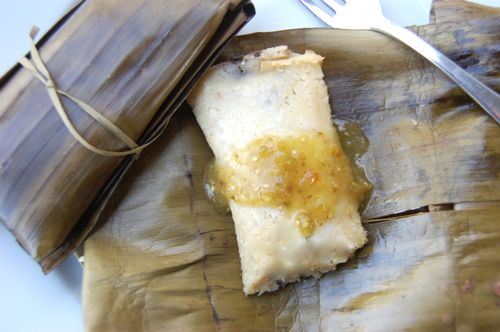
Rick Bayless calls these Juchitán-style tamales, which is a word I love to say: “hoochie-TAHN.” Juchitán is a city located in the southeastern Mexican state of Oaxaca (also fun to say: wah-HOCK-ah). It’s a town known for food, art, cross-dressing and indigenous languages. Don’t ask me about the third thing, it’s a long story…Mrs. Pastry will tell you all about it if you ask her, she was in Juchitán in November on a research project.
READ ON
Now just to be clear, I don’t have to eat the wrapping too, do I? I remember quite clearly asking that question when I was first confronted with non-convenience store tamales. How the heck do you eat these things? It’s a fair question for any inexperienced tamale-eater, since very few foods land on our dinner plates still in the wrapping…unless of course Dad got lazy dishing up the Happy Meals at the kitchen table this week (something you can pretty much count on at our house).
READ ONThe functional advantages of nixtamalization are just the beginning of what the process brought to the ancient Mesoamericans. For in the act of making their corn easier to handle and eat, Mesoamerican cooks accidentally unleashed a torrent of nutrients that would otherwise have been unavailable to them. For nixtamalization, it turns out, vastly increases the amount of free niacin present in corn, and renders the protein that it contains much more absorbable by the body.
What’s niacin? We know it as vitamin B3. It’s an essential nutrient, without which the body’s metabolism begins to slow down. Left unchecked a severe niacin deficiency leads to a disease called pellagra. What’s pellagra? Well, Europeans — especially Italians — found out all about it when
READ ON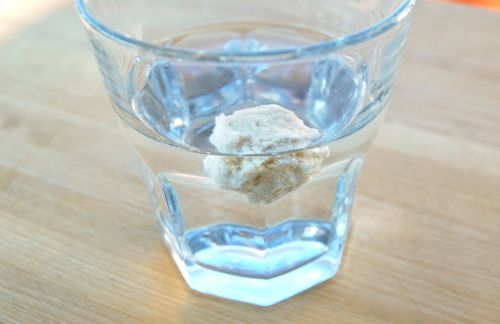
Corn masa for tamales is an easy thing to whip up, especially if you can lay your hands on fresh masa straight from a tortilleria. Failing that some good instant masa is a fine substitute (make sure it says “for tamales” on the package). Here are proportions for both.
READ ONHeck no. I may render my own lard, but when it comes to making masa, I leave that to others. Back home in Chicago I was spoiled. I lived among hundreds of thousands of Mexicans, which meant fresh-made masa was readily available in grocery stores (the ones that catered to the Mexican population, anyway). Louisville doesn’t have nearly enough Mexicans to warrant a tortilla bakery (not yet, anyway), and that’s where fresh masa comes from. Until one of those is put up (hm…possible new business venture?) I make do with the dehydrated stuff.
READ ONMasa is a unique corn dough that’s the basis for both tamales and tortillas. More than just a simple combination of ground corn and water, it’s actually made from corn that’s been nixtamalized. That’s quite a mouthful of a word, and it refers to corn that’s been treated with a weak alkaline solution. It comes from the Aztec word “nixtamal” which, loosely translated, means “ash dough.”
Not very appetizing by the sound of it. However what ancient Mesoamericans discovered 3,500 years ago is that when you boil and then soak raw corn kernels together with ashes, some very interesting things happen. Most noticeably, the outer hulls (pericarps) of the kernels loosen to the point that they can be slipped off.
READ ONChiles are so central to so many world cuisines, it’s easy to forget that they all originated in the New World. Szechuan chilies, Thai prik kee noo, Indian phiringi jolokia…all of them originated in Central America, more precisely the region of modern-day Ecuador, where locals have been cultivating chiles for some 6,000 years. Indeed Hungary would have no paprika whatsoever had Spanish and Portuguese traders not instigated the chile pepper diaspora in the late 1400’s. Mozambicans wouldn’t have shrimp pili pili, Moroccans no harisa, Malaysians no sambal.
READ ONDon’t worry, capsaicin addicts (especially you, reader Malini), de-seeding a chile does very little to diminish its heat. Yes, the seeds contain some of that crazy fire juice, but the vast, vast majority of it is found in the placental regions of the pepper, in other words the pale tissues that stretch along the inner walls of the pepper and connect to the base of the stem. This is where about 90% of the capsaicin in the chile is kept. Remove the seeds (which are attached to the placenta) and you do little to reduce the chile’s punch.
READ ON…and erroneous besides. Yes that’s quite true, reader Cynthia. All that really needs to be said is “chile.” It’s thought that Christopher Columbus himself was the first to start calling chiles “peppers” since he had no other frame of reference. Chiles certainly didn’t look like peppercorns to him (chiles are large berries and peppercorns are tiny drupes), but the effect they had on his taste buds was similar.
READ ON