Gear Essentials: Mixing
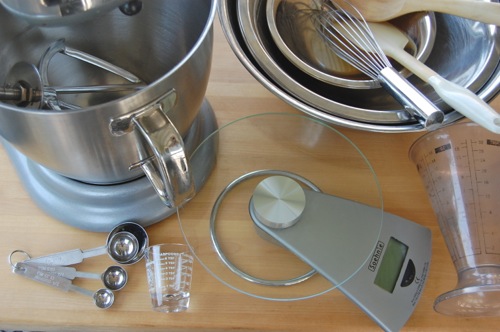
Of all the baking gear I have, my mixing equipment gets by far the most use. ‘Cause let’s face it, pretty much everything in pastry has to be mixed. Not necessarily by machine of course, but I myself would be lost without a stand mixer. But let’s not get ahead of ourselves. Mixing starts with measuring, so I use (mostly) a scale. A scale is essential for dry ingredients like flour which can vary quite a lot using dry measures and the ol’ dip-and-sweep method. A scale that does metric as well as imperial is handy when you’re converting a Continental recipe.

READ ON

Poly-Unsaturated Snake Oil

Reader Andy writes:

There is a buzz right now about coconut oil and that it is actually good for you. I remember not too long ago when it was deemed the Devil incarnate. It is possible for one saturated fat to be better than another?

It’s certainly possible, Andy, though I personally I tend not to put much faith in these sorts of flavor-of-the-month claims. It’s true that when saturated fats were thought to be the root of all evil, coconut oil was considered to be The White Death. That’s understandable since coconut oil is over 90% saturated fat (compare that to butter which is about 65% saturated fat).

READ ON

This Week is Gear Week

Hello Joe readers! I’m back and unscathed from my trip to Mob Central, which is good news for me…so-so for most of you guys. For a while now I’ve been getting requests for a series of posts on baking gear. I’ve procrastinated because I haven’t known where to start and I’m lazy. However now regular reader and commenter Ann is getting married and needs to know what to tell her relatives to buy. So there’s an imperative here. I’m planning to start a series that goes from the basic must-haves up to the ridiculously specialized and unnecessary. If you have input, by all means send it. I’ll put this series up in the Baking Basics category for all posterity. So don’t hold back!

READ ON

So how does hydrogenation work?

I’ve blogged on this subject in the past, but will happily re-summarize in light of the recent posts on oil, fat and frying, reader Sally! As outlined below, frying fats that are solid at room temperature are desirable for a number of reasons. But if solid animal fats are either too expensive, too rare or off the table for dietary or health reasons (as they were twenty or so years ago) what is there to do? The answer of course: turn liquid oils into solid fats.

That’s what a German chemist by the name of Wilhelm Normann did in 1902. He found that if one were to bubble hydrogen through liquid oil in the presence of a catalyst metal, unsaturated fatty acid chains would pick up hydrogen atoms (remember those teachers and school children from the post below). The result would be a solid oil, also known as a “fat.”

READ ON

Making Sicilian Cannoli

Hey. Your regular guy Joey ain’t here right now. He had to go see a guy about a thing, knowadimean? I’m his cousin Paulie. I’m here to make sure he doesn’t get this whole cannoli thing fudged up, pardon the French. ‘Cause ya know there’s no bakery cannolo in the world that beats the kind you make at home, which are so friggin’ light and so friggin’ rich and so friggin’ crunchy it makes me about to wanna friggin’ die. Jeez there I go again with the French, sorry. I told Joey I’d watch my friggin’ mouth. Ah, shhhi—

READ ON

Will we ever go back to fat?

Reader Samantha asks:

Why is shortening used over lard as a solid fat in commercially made products? Is it the cost?

Goodness gracious, Samantha, is that ever a great question. If only I had some of my former clients from McDonald’s corporate headquarters here to help me answer it. For as you may know, up until 1990 McDonald’s fried its legendary French fries in beef tallow (fat). That was the year when they finally succumbed to public pressure, whipped up by groups like the Center for Science in the Public Interest, to change over to vegetable shortening, which was supposed to be better for us.

READ ON

Shortening Versus Oil

So why do some people use solid fats to fry and others use liquid oil? An excellent question, reader Jay. As many people know, just about all commercially made, oh, doughnuts for example, are fried in solid shortening. They could in theory be fried in liquid oil, but solid fats offer several important advantages, among them a greater resistance to breakdown and rancidity.

READ ON

How long have I got, doc?

How long does it take for good fry oil to turn bad you mean? That depends on a number of factors, chief among them the type of oil/fat you’re using. In general, you want a frying medium that’s fairly stable (i.e. resistant to breakdown) and neutral flavor-wise. For me that means either vegetable or canola oil. Solid fats like shortening or lard are even more resistant to breakdown, but are less convenient for the home fryer.

READ ON