Cool!
Now that’s a great way to separate an egg! Still it’s no fun for me if I don’t get my hands all gooey. Thanks, reader Rainey!
READ ONNow that’s a great way to separate an egg! Still it’s no fun for me if I don’t get my hands all gooey. Thanks, reader Rainey!
READ ONHere’s something a little different, a bread (“pan”) that’s actually more like a confection. It comes originally from the city Siena in Tuscany. There are probably as many ways to make it as there are people in Siena. I like Gina De Palma’s version, so we’ll go with that. Apologies to reader Linda to whom […]
READ ON
Many a little old lady has trodden caramel cake territory. Go there and you’ll find yourself getting in touch with your inner granny, the one with the heavy orthotic shoes, lace collar and tinge of blue in her hair. I did and I can tell you that it made me a better baker. However later I found myself complaining about street crime, the rudeness of pharmacy clerks and the scandal of mini skirts. It was a double-edged sword.
READ ON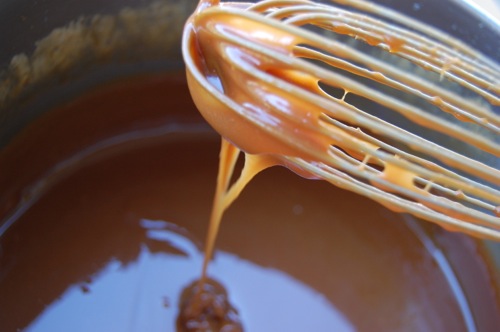
I had a great time making this icing today. On the one hand there was the caramel, which I get all worked up about. Something about turning simple, one-dimensional ingredients like water, sugar and milk into a deep, dark, aromatic brew…it excites me. On the other there was the browning which the geek in me loved, created as it is by both caramelization and Maillard reactions. Put it all together and my little brain was lighting up like a Christmas tree.
READ ONReader Eva writes:
You reminded me of a question I’ve been meaning to ask. When a recipe calls for heavy cream or a specific type of milk like whole, what are the pitfalls of substituting a lower fat product (say half-n-half for the cream and nonfat for the whole)?
Hey Eva! There are consequences, but seldom catastrophic ones. Dairy fat is a moistener and flavor booster, so cutting back to skim milk from heavy cream will probably be noticeable. However if you’re just scaling things back a notch or so as you describe, you won’t detect much difference.
READ ONI think I need to change the caramel cake layer recipe. The first run-through went well enough, however the layers are so heavy that I just don’t think I can live with it. I mean, a stick of butter per layer…yow. So I’m taking out one stick of butter and replacing the heavy cream with […]
READ ONReader Annemarie writes:
So Joe, can you enlighten me where in a pan are you supposed to take a thermometer reading? I was making a lemon tart (Heston Blumenthal’s recipe sorry) at the weekend and it says to take the custard to 62C, I was using my thermometer but depending on where I put it I got different (like much different) readings. I was bringing this custard up over a pan, and I must have stood there for an hour stirring stirring stirring until I finally thought “oh blow it” and bunged it all in the tart case and put it into the oven…it came out perfect by the way, but what a faff!
I think pretty much everyone has had a similar experience, Annemarie. Glad it worked out in the end. Temperature variations like that occur in all pans, especially if they’re broad and shallow. So to begin with you want to select a saucepan that’s thick, deep and with high sides, hopefully one that fits squarely over the heat source. The idea here is that a thick-sided pan will distribute the heat more evenly, and keeping the custard (or whatever it is) compact will not only help with heat distribution, but will cut down on evaporation which cools the mixture.
READ ON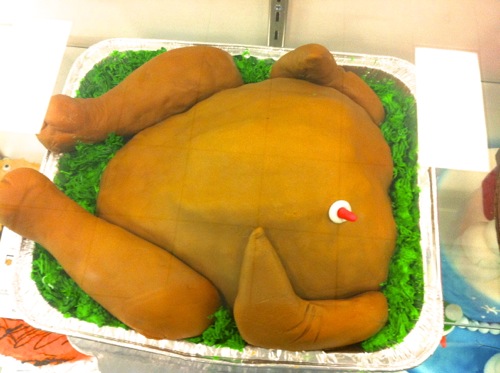
The Pastry clan visited the Kentucky State fair over the weekend, and as always I spent a good deal of time scrutinizing the baked goods. Of course we can’t taste anything, so it’s always the cakes that are the most fun. There’s always a strong trompe l’oeil contingent. I loved the roast turkey up above, but then how can you not appreciate a spaghetti and meatballs cake…
READ ONReader Kitty writes:
So the whole putting a can of condensed milk in a pan of boiling water thing makes caramel because of the pressure cooking and thus shortens the time? Or perhaps they are a bit more base as well… hmmm.
Hey Kitty! It depends on the technique you use to make dulce de leche. If you do it the old-fashioned way by simply simmering milk and sugar for an hour or so, you get Maillard-type browning initially, and then caramelization. If you boil a can of sweetened condensed milk in a saucepan, you just get caramelization.
READ ONTwo related comments came in over the weekend in regard to sugar and soda. First this observation from reader Julie:
READ ONAnother thought on the baking soda: milk heated with acid will curdle every time, and caramelized sugar becomes more acidic as it darkens. I like my caramel reasonably dark, so I’ve run into problems with curdling milk on more than one occaision. I find it also helps to use plain refined white sugar, as a blonde organic sugar (with a little residual molasses left in) will contribute to curdling.