And They Shall Call Him Crusty

The third and final story I know about the origin of panforte takes us all the way back to the birth of Christ. Indeed it seems that the Magi weren’t the only ones who were led to the Christ Child by the Star of Bethlehem. According to Siense folklore a an orphan was likewise inspired to visit the stables where the infant Jesus lay. There he offered the only gift he had, a small crust of bread. As the story goes, Joseph took the bread, gave a few crumbs to the birds that were nesting in the rafters, and handed the crust back. Crushed, the boy went home to his grandmother, sobbing. When he arrived home he was greeted by a vision of his mother, surrounded by heavenly light, and his father clad in gleaming armor. On the table was a banquet, the centerpiece of which was…you know the rest.

READ ON

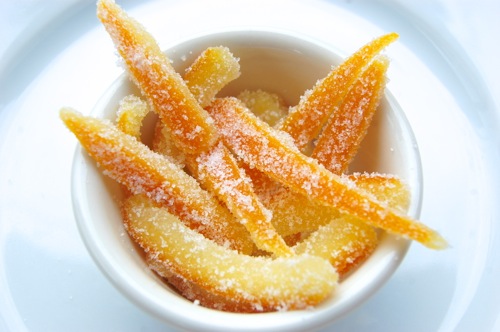
Candied Orange Peel Recipe

Make these once and you’ll probably never throw orange (or any citrus) rinds away ever again.

3 navel oranges
2 cups sugar
1 cup water
1/4 cup light corn syrup, glucose syrup or honey

Wash and dry the oranges, then cut off the very ends and score them in quarters from top to bottom. Peel the rinds off the fruit, trimming away any excess pith, then cut the rinds into 1/2″ slices.

READ ON

Lead Us Not Into Temptation

Next up is a supernatural twist on the old silk-purse-out-of-a-sow’s-ear story line that’s popular in food origin myths. It centers on a young novice nun by the name of Leta, also a resident of Siena. So it goes, one day she was cleaning out the cupboards in the nunnery when she discovered a heap of sugar and spices on a shelf (pesky mice chewed holes in the sacks, donchaknow). With no convenient receptacle handy, she scooped the whole mess into a pot and, since she realized she could use a little something sweet to eat, set it over the fire.

READ ON

Remembering Montaperti

There are quite a few good stories about the invention of panforte. Myths are what they are, but they’re a little weirder and/or more creative than the typical Pope-coming-to-dinner narratives you encounter with Medieval foods. Many involve a nun by the name of Sister Berta who is said to have lived sometime around the 13th Century in, of course, Siena.

The first story unfolds in the aftermath of a siege of the city. Sieges being what they are, supply lines were cut off for months. Eventually it ended (Siena evidently won), but once the jubilation wore off, Berta began to notice how emaciated the Sienese inhabitants looked. Diving into her stores of nuts and dried fruits, she created a compact, long-keeping high energy food. The locals called it “panforte” because it made them strong, and Berta went on to become the patron saint of the highly profitable nutritional/snack/energy bar category. OK, I made that last bit up. But then the whole thing is made up. What kind of nun hoards fruits and nuts during a siege, only to give them out later when it’s over?

READ ON
Where does panforte come from?

Siena, Tuscany, one of Italy’s most beautiful Medieval cities, is considered the home of panforte. Apparently there are Sienese documents dating to the year 1205 that mention it. Evidently panforte was recognized as a form of currency in the city then, and was offered by the citizenry to a local monastery and nunnery as a sort of tax payment. A city that uses candy as money would be a dream come true for my daughters. Remind me to weave this place into their bedtime story tonight.

But one document does not a place of origin make. So at the risk of committing a blasphemy, I’d like to propose a little thought experiment. Imagine it’s the High Middle Ages and you’re living in northern Italy. Your name is Leofrick the Spotty and you work as a kitchen laborer on the estate of the local lord. Word has arrived by courier that your master will be returning from a crusade to Jerusalem this week, and your first thought is: let’s bake a cake for the fellow to eat, assuming some mace-weilding Seljuk didn’t knock all his teeth out at the Battle of Antioch the previous spring.

READ ON

Panforte Recipe

This is a very Christmas-feeling sweetmeat, but can really be enjoyed any time of year. I’ve drastically reduced the amount of spice to make it more of an anytime treat. To give it the full-on yuletide treatment, triple the cinnamon and double the cloves. For those who like theirs spicy — and the original version of this dish were quite spicy — add a teaspoon or so or fresh ground black pepper. You can even spike it with a little cayenne if you want!

16 ounces (3 cups) blanched whole almonds
9 ounces (1 3/4 cups) whole hazelnuts, skinned or unskinned
12 ounces (2 cups) diced candied orange peel
6 ounces (1 cup) dried apricots, diced
5 ounces (1 cup) dried figs, diced
5 ounces (1 cup) bleached all-purpose flour
2 teaspoons ground cinnamon
2 tablespoons cocoa powder
1 teaspoons salt
1/2 teaspoon ground cloves
16 ounces ounces (2 1/4 cups) sugar
16 ounces honey (1 1/3)
3 ounces (6 tablespoons) butter
powdered sugar for dusting

READ ON