On the Advantage of Syrups

I took this post down for the evening because I accidentally created some internecine warfare between a couple of my food science sources and I needed a little time to get my facts straight. Reader Bronwyn (quite helpfully I might add) challenged my early contention that hot syrup doesn’t cook egg whites in any meaningful way. Having had a little past experience taking meringue temperatures, I was sure that there was no real cooking going on. This set off a little debate on what exactly was meant by the term “cooking”, and things got confusing quickly. But anyway, here’s Michael’s original question:

I understand that when you add sugar syrup to egg whites to make Italian Merengue it cooks the whites a bit making it more stable than adding plain sugar. I’m curious if the purpose is the same when adding sugar syrup instead of plain sugar to yolks. I made a recipe for a “chocolate roll” which is to add a “light” sugar syrup to yolks and beat until light and fluffy. Then add in melted chocolate with a bit of coffee. Finally fold in stiffly beaten egg whites. Then bake and then fill the roll with whipped cream. Why would the recipe call for sugar syrup to [be beaten into] the yolks instead of plain sugar ?

READ ON

Who Was Hannah Glasse?

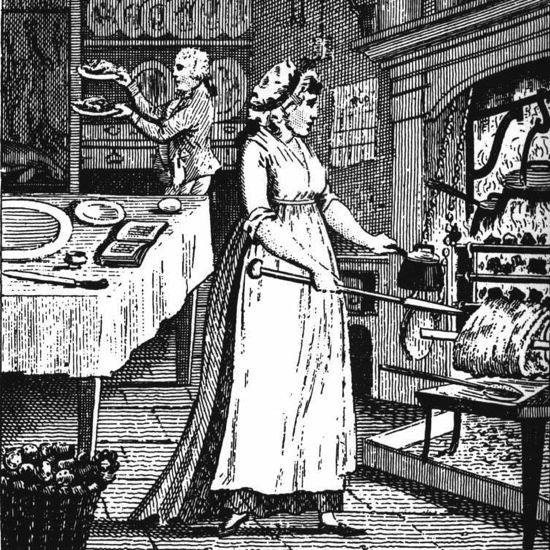
She isn’t just some obscure name out of a musty old British cookery book. Rather she is the obscure name out of musty old British cookery books generally. At least those from the Georgian period. Glasse was the most well known cookbook writer of her age, author of (and I’m quoting the full title now) The Art of Cookery, Made Plain and Easy, Which far exceeds any Thing of the Kind ever yet Published.

So there.

READ ON

Progressive Baking, Victorian Style

Reader Chana writes:

I’ve seen quite a few pound cake recipes that call for a bit of leavening, like baking powder. I generally think of this as “cheating.” But in truth, I’ve made pound cakes that I thought were much too dense, so baking powder begins to sound like rather a good idea. (I know, shame on me.) Any thoughts about using leavening in a pound cake? Also, using cake flour rather than AP flour is a great idea, and probably goes a long way in making the cake a bit less dense without the use of any leavening. I’ll give this a go, I think it will be great with the last of the berries.

Very interesting that you should write this note just as I was preparing this post, Chana. Below are a couple of recipes that show the evolution of pound cake-making technique. As you can see, a little supplemental egg foam was considered in-bounds back in 1824. However you can also see a sort of proto-creaming method taking shape here:

READ ON

A True Heavyweight

Pound cake is a treat that’s been passed down to us, mostly unchanged, from the late Colonial Period. Eating it I imagine myself standing on a veranda somewhere in New England during the American Revolution, resplendent in my powdered wig, waistcoat and pantaloons. But then I remember my anemic calves, and how pathetic they’d have looked in knee-high socks. Some of us were just made for cargo pants.

Pound cakes are called pound cakes because the original recipes called for only four ingredients, a pound of each: flour, butter, sugar and eggs. Quite easy to remember, no? Though as I remarked below a four-pound cake would have been some kinda beast. Given the oven technology that was available at the time, most of them would have been extremely hard and dense. This was probably intentional. In the event the ammo ran out they could be fired at the British. The first known printed recipe dates to 1747:

READ ON

Pound Cake Recipe

Pound cakes haven’t changed all that much since the days of the “four quarters” cakes made with a pound each of butter, eggs, sugar and flour. That makes a hell of a big cake, and one that tends to dry out in the oven before it’s done. Modern versions are not only smaller, they’re tweaked to produce a slightly lighter product. Still you can see that there’s roughly 9 ounces of everything in here:

9 ounces (2 cups) cake flour
generous pinch salt
5 eggs, room temperature
1 teaspoon vanilla extract
8 ounces (2 sticks) butter, softened
9.25 (1 1/3 cups) ounces sugar

READ ON

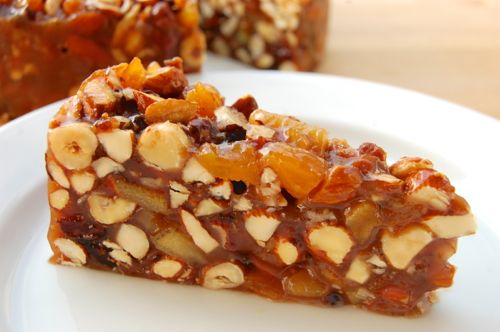
Making Panforte

There are two kinds of panforte, “white” and “black.” White generally has more dried fruit in it, and is usually dusted with powdered sugar. The black version is generally spicier, nuttier and calls for cocoa powder (a novelty back when these cakes/candies first became popular). This panforte, quite frankly, is somewhere in between. But then why should I adhere to tradition when so few Italians do? Go to Italy and you’ll find hundreds of variations on the theme. For ideas on how to vary yours, refer to the recipe below. Begin by preheating your oven to 325 degrees Fahrenheit and roughly chopping the dried fruits and nuts:

READ ON