How Big is the Pop Tart Empire?

Reader Dean asks if I know how many — and how many kinds — of Pop Tarts are made by Kellogg’s each year. The total number is close to four billion if you can believe it. That’s more than 10 million every day. Given numbers like that it’s no wonder their corporate lawyers aren’t pounding down my door demanding I cease and desist using their brand name for a blogging project. Assuming every reader who visited me this morning went on to make a batch of homemade “tarts” I’d cut into their sales by a few thousand at best. Maybe a few hundred bucks in profits. Talk about a yawner. Their lawyers charge them that much just brushing their teeth in the morning.

READ ON
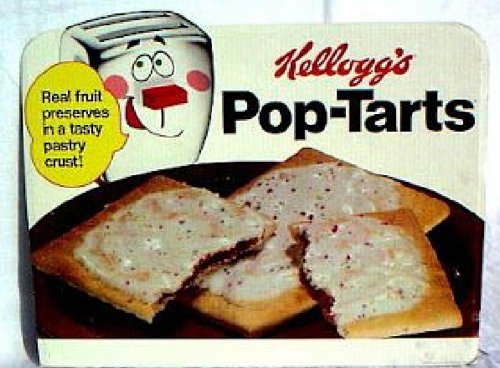
What’s in a Name?

Oh, maybe a billion bucks, give or take. But let’s back up a little. When last we left our hapless heroes at Post Cereals it was 1964. They were alerting the media about their big idea of packaging pre-made toaster-ready jam turnovers in metallized mylar packets. Announcements started appearing in national papers that week.

That Thursday over at the Kellogg Company, CEO J.P. Bigshot was following the story closely. “Say, that’s a pretty good idea,” he said through a mouthful of doughnut. “But what’s Post calling these things? Country Squares??? That’s about as exciting as a Beverly Hillbillies re-run. Miss Jones, get me the R&D department.”

READ ON

What is turbinado sugar?

So asks reader Rick. Rick, it’s a very similar thing to demerara or muscovado sugar, which is to say it’s a lightly processed brown sugar. However compared to others it’s got a high moisture content, which makes it nice for melting and caramelizing. Some people prefer it for crème brûlée for that very reason. No […]

READ ON

Oh and did I mention…

…that metallized mylar not only keeps gasses out, it keeps light out. About 99% of light. That’s nice for packaging things like camera film (not that anyone uses it anymore). However it also means you can view an eclipse of the sun through a Pop Tarts wrapper. It’s not technically recommended since manufacturing standards vary […]

READ ON

It All Started With Polyester

The inspiration for the Pop Tart wasn’t a recipe, it was a packaging material. A product called BoPET (Biaxially-oriented polyethylene terephthalate) otherwise known as Mylar. It’s a stretched polyester film that we mostly take for granted now, but in the 1950’s was considered a miracle product. Then, consumer goods makers had precious few choices when it came to containers or wrappers to put their…well… “stuff” in. You had cans, you had boxes, drums, cartons and crates, but that was pretty much it. And all of them had their limitations when it came to durability or resistance to environmental conditions like heat, cold and moisture. And if you wanted consumers to be able to actually see your product in the package, forget it (unless you could stuff whatever it was into a glass bottle).

READ ON

Baking with Bourbon

Back about the time of the bourbon festival, reader Julie asked for a few bourbon-infused baking ideas. This morning reader Linda kindly forwarded this link full of boozy recipes. If there are any keys to successful baking with bourbon, I’d say they are: a.) employ it only in very sweet preparations, since bourbon is a comparatively sweet liquor; b.) combine it with similar vanilla and especially caramel flavors like brown sugar and molasses, and; c.) unless you want a strong alcohol flavor, employ it only in situations where the alcohol can easily cook out: sauces or things made in shallow pans (thin pies, bars or cookies). Remember, however, that even a sauce that’s thoroughly boiled won’t rid itself of every vestige of alcohol. So if you don’t want any in your dessert, use a different flavoring. Thanks Linda!

READ ON

Yolks Hard & Soft

Reader Daniel asks:

I was wondering if you might have an insight into a question I have been trying to answer for quite some time. In some traditional cake recipes from central Europe (usually cakes that involve ground nuts as well, like a Linzer), the dough calls for the addition of hard-boild egg yolks, passed through a sieve. I always wondered what this is supposed to do to the consistency of the cake vs. using raw yolk, and what may have prompted the bakers to use yolks in such an unusual way. Do you happen to know anything about that?

Great question, Daniel! The answer is that hard boiled egg yolks are a tenderizer. Consider that for the most part wheat flour is the “bulk” — the building material — of a cake. There’s just one complicating factor: it contains gluten. That gluten is important to some degree. The network of intertwined molecules helps trap the gas and steam that allows the cake to rise.

READ ON

Are you a recipe creator?

Months later, I’m still buzzing a bit from our family trip to North Carolina and the Asheville area. So when an Asheville culinary institution, The Tupelo Honey Cafe, asked me to help them promote their recipe contest, I couldn’t say no. This year they’re accepting entries in the categories of sides, desserts and leftovers (love that). If you have an inspiration, send it on in. You could win a cookbook or a $200 gift certificate.

READ ON

Chocolates, Suspensions, Emulsions, etc.

Reader Angela writes with this fascinating question:

I have a question that’s bothered me for years, and it occurred to me recently that you might be able to answer it. I know that when you’re melting chocolate, it’s important not to let any water get into the chocolate or it seizes and gets all grainy. However, why doesn’t chocolate get grainy when you melt it with butter or whisk cream into it? At first I thought it must have something to do with the fat and water being emulsified in the cream/butter, but when you melt butter you break the emulsification so it can’t be that. Any ideas?

Oh I always have ideas, Angela. Whether they’re at all based in reality is another matter. Just ask Mrs. Pastry. But you’re very right that the act of melting butter breaks that particular emulsion, however in the process of whisking it together with chocolate, new emulsions and/or suspensions are created. But let’s back up for a moment.

READ ON