St. Lucia Day

As mentioned below, the Feast of St. Lucia is celebrated with particular verve in Scandinavia. Given how short the days are come December, it makes all the sense in the world that they’d set a day aside to honor the patron saint of light. But if these folks were really serious about celebrating light — especially daylight and the return of longer days — wouldn’t it have made more sense to honor St. Lucy on the 21st of December? That’s the winter solstice, after all.

Interestingly, December 13 was the winter solstice at the time the Feast of St. Lucy was established. This wasn’t because people during the High Middle Ages couldn’t measure the passage of time accurately, but because they lived according to the old Julian calendar, which as we already know had been diverging from actual solar time since it was instigated in 46 B.C.. Thus the feast of the patron saint of light would seem to have some rather suspicious origins. Indeed it seems quite likely that it was a (successful) Catholic attempt to co-opt a major pagan festival.

READ ON
Butter, and Better Butter

Reader Kempy writes:

It seems to us that there is a big difference in really good butter and ones that are not always cheaper but seem very watery. Are there laws on the amount of water in butter, or ranges of the amount of water that would allow us to know if we are getting good butter?

Hey Kempy! There definitely are laws regulating water content in butter. American butters can contain no more than 16% water and must be at least 80% milk fat (the rest is protein, lactose and, perhaps, salt). However it’s not so much the water content that’s important as the fat content. Higher quality butters will have more, and even a percentage point or two makes a big difference. French butters, for example, must be 82% fat by law, with some going as high as 85%. Of course French butter is also cultured, which means it tastes a cheesy/tangy as well. You can often check fat content on labels, so let that be your guide.

READ ON

Who was St. Lucia (Lucy)?

It’s a logical question, no? We Catholics have a lot of saints, which we employ for a variety of household purposes. But St. Lucy is one of the special ones, and very old. In fact she’s so old that very little is known about her. She lived during the Great Persecution, a ten-year period that started in the year 303 when a series of laws were passed erasing the limited legal rights of Christians in the Roman empire. Under them, all Christians were ordered to observe Roman religious practices (make sacrifices to Roman gods, etc.) on pain of death or imprisonment.

Lucy was one of those Christians, a native of Syracuse, Sicily, who at the time was engaged to a young Roman pagan-about-town. Her father had died many years prior and her mother had arranged the marriage as well as a substantial dowry. Things were going as planned until Lucy was visited by a vision of St. Agatha who told her she had a big future ahead of her as devout — and chaste — servant of the Lord. Once that happened she instructed her mother to give her dowry away to charity and her fiancé to get lost.

READ ON

St. Lucia Buns (Lussekatter) Recipe

These lovely “S” shaped buns are commonly made with quark (kesella) but that’s not terribly easy to find in the States. Mascarpone is an excellent substitute (homemade if you’re feeling ambitious!). Crème fraîche can also be used, but sour cream is perfectly good as well. Most recipes for these call for fresh yeast, but I’ve converted it instant. As my dear departed grandmother Margaret liked to say “why not do it the easy way?” God she was a great lady. Anyway, here’s what you need:

1 gram saffron threads
16 ounces (2 cups) milk
2 lbs. 3 ounces (7 cups) all-purpose flour
4.5 ounces (2/3 cup) sugar
1/2 teaspoon salt
2 tablespoons (20 grams) instant yeast
8 ounces quark or sour cream (room temperature)
3.5 ounces (7 tablespoons) soft butter
egg wash
raisins (optional)

READ ON

Next Up: St. Lucia Buns (Swedish Lussekatter)

Also known as “Swedish saffron buns” in some quarters, St. Lucia buns are traditionally made and consumed on December 13th in Scandinavia (the Feast of St. Lucia). They are a type of brioche infused with saffron and enriched — or should I say further enriched — with a farmer’s cheese called kesella which we know as quark. They’re rolled into a “S” shape and baked in a hot oven. The result is rich, moist and extremely addictive. Let’s do this thing.

READ ON

Submit Your Rice Pudding Here!

I’ve received many requests to post rice pudding recipes from around the world. The trouble is I don’t know them. However many, many of you have described the rice puddings you grew up with, so…post them! Right here in the comment fields. Other readers will thank you for it. Oh, and please make sure that […]

READ ON

Making Rice Pudding

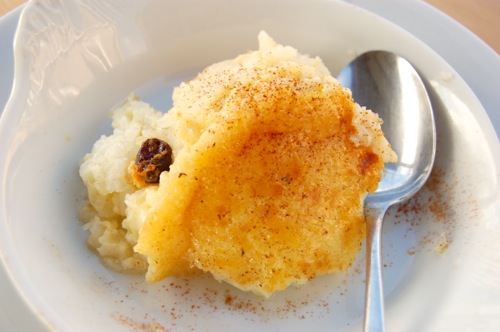
Americans often have a tough time making rice pudding since our long grain rice tends not to bake up well when it’s added to custard in its raw state. The solution: make rice pudding with cooked rice. The result is every bit as delicious, plus it’s convenient if you order out a lot of Chinese food. The individual rice grains tend to maintain their integrity at bit more — i.e. are a bit chewier — but I like the contrast. Here I should note that everyone has their own favorite version from childhood. I’m not putting this forward as the standard by which all rice puddings should be judged. It happens to be one I like.

READ ON

Where does rice pudding come from?

That’s a bit of a toughie. Grain gruels are the oldest prepared foods on the the planet. That being the case it stands to reason that rice pudding was first invented in China where rice was first cultivated on a large scale. However if I were to guess I’d say India, which not only has an ancient rice culture, but also an ancient sugar culture. Put the two things together and you have the basis or rice pudding as it’s now known.

What I find interesting about rice pudding is that its use hasn’t changed all that much over the millennia. Yes it’s delicious and nourishing porridge, but it’s also medicinal: good for people with upset stomachs. Ancient Asian and Middle Eastern peoples knew that, as did the Romans and Medieval Europeans, for whom rice was so rare and precious that it was in fact administered as a medicine.

READ ON

Rice Pudding Recipe

Like all custards rice pudding can be either stirred (made on the stovetop in a saucepan) or still (baked in a dish in the oven). Personally I like a baked rice pudding since you get a greater variety of textures: a browned top, moist center, firm sides…oh yes much more interesting than a typical stirred pudding. The recipe goes like this:

2 eggs
12 ounces (1 1/2 cups) whole milk
1 teaspoon vanilla
1/4 teaspoon salt
3.5 ounces (1/2 cup) sugar
1/2 teaspoon ground nutmeg
1 teaspoon grated lemon or orange zest (optional)
7.5 ounces (1 1/2 cups) cooked rice
2.5 ounces (1/2 cup) raisins
cinnamon for dusting

READ ON